
If you are flying to Vilnius, you may encounter Čiurlionis before you even reach the city centre. From 2025 until the end of 2029, Vilnius International Airport has been given the symbolic name Vilnius Čiurlionis International Airport, honouring one of the most remarkable figures in Lithuanian culture. Who was Čiurlionis, and why does he hold such a special place in Lithuanian culture? The short answer is that he was difficult to put into a single category.
Čiurlionis was a composer, painter, writer and visionary, fascinated by everything from mythology and astronomy to philosophy and science. During a remarkably short creative life, he produced around 400 musical compositions and more than 300 paintings. And perhaps most intriguingly, he seemed to experience music and visual art as two sides of the same world.
A remarkably creative life
Mikalojus Konstantinas Čiurlionis was born on 22 September 1875 in Senoji Varėna, in southern Lithuania. He died in 1911, aged only 35.
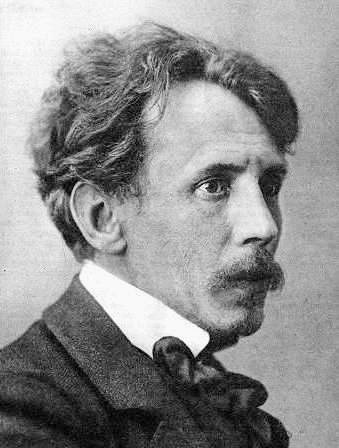
M.K. Čiurlionis (picture from Wikipedia)
His professional artistic career lasted barely a decade, but during that time he managed to leave an extraordinary mark on Lithuanian culture.
As a composer, he wrote symphonic poems, piano works, chamber music, choral compositions and other works. At the same time, he developed rapidly as a painter, producing hundreds of paintings and graphic works.
His interests went far beyond music and painting. His notebooks from his years studying at the Warsaw Music Institute reveal a remarkable curiosity about geology, history, chemistry, geometry, physics, astronomy, mythology, philosophy and religion.
In other words, Čiurlionis was not simply interested in creating beautiful things. He was trying to understand the world.
When music becomes a painting
This is perhaps the most fascinating way to approach Čiurlionis. Many of his paintings do not depict a particular place that you could simply visit. Instead, they create worlds.
There are mysterious landscapes, stars, planets, castles, forests, angels and strange imaginary creatures. Some paintings feel almost like dreams; others seem to suggest the creation of the universe itself.
And music is always somewhere in the background. Čiurlionis often gave his paintings musical titles such as Sonata, Prelude and Fugue. His paintings can therefore be experienced almost like musical compositions – with recurring themes, rhythm, movement and changing moods.
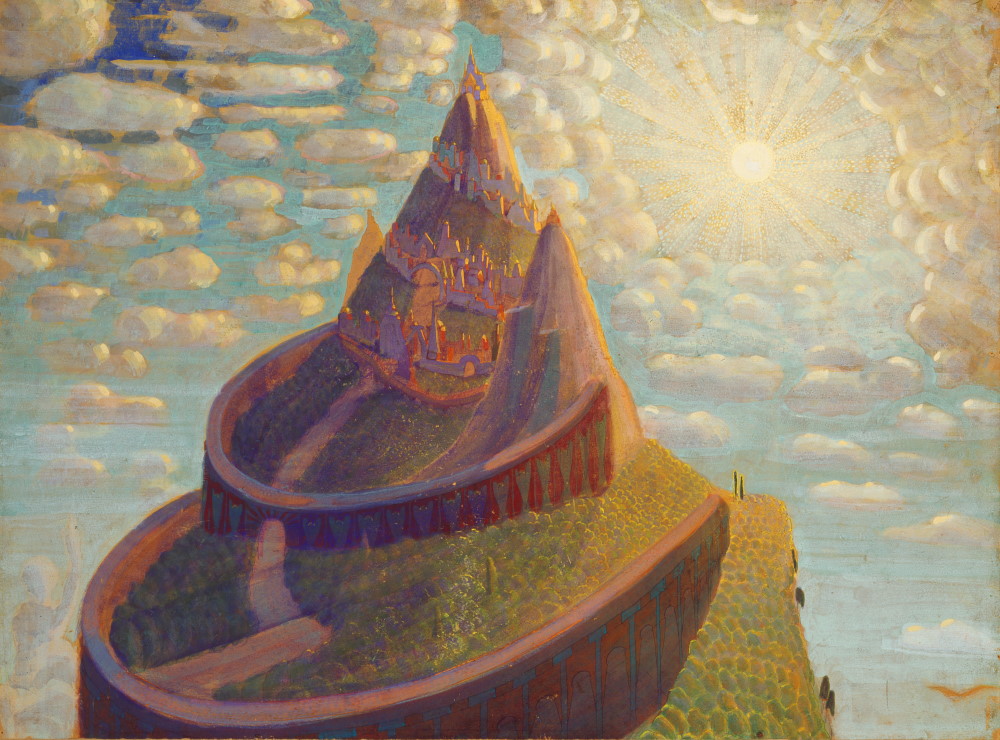 Painting by M. K. Čiurlionis 'Pilies pasaka' ('The castle's fairytale', picture from internet)
This connection between sound and image is one reason his work still feels surprisingly modern today. He lived at the beginning of the 20th century, but some of his paintings can feel much closer to modern abstract and experimental art than to the traditional European painting of his time.
Čiurlionis and Lithuanian culture
Čiurlionis also lived during an important period in Lithuania's history. At the beginning of the 20th century, Lithuanian national culture was experiencing a revival. Language, literature, music and art were becoming important ways of expressing a distinct Lithuanian identity.
Čiurlionis became one of the central figures of this cultural movement. His work combined the universal with the distinctly Lithuanian. He was inspired by European artistic ideas, but also by Lithuanian folk music, mythology and nature.
That combination is part of what makes him so important today. Čiurlionis is not simply an artist from Lithuania's past – his work has become part of the way Lithuania understands and presents its cultural identity.
Step inside Čiurlionis's paintings in VR
There is also a much more contemporary way to discover his imagination. At the Immersive Art Centre on A. Vienuolio Street, visitors can experience two virtual reality works inspired by Čiurlionis: Trail of Angels and Creation of the Worlds.
Trail of Angels takes visitors on a poetic journey through imaginary worlds inspired by Čiurlionis's paintings. Created by director Kristina Buožytė and producer Vitalijus Žukas, the experience combines his imagery with music and sound and has already been seen by more than 400,000 people. It has also received international awards, including the Lumen Prize for Art and Technology.
Creation of the Worlds, created for the 150th anniversary of Čiurlionis's birth, goes even further. Using VR, animation, music and sound, it explores ideas of the birth of the universe, the rise and fall of life, and rebirth, culminating in one of Čiurlionis's best-known works, The Tale of the Kings.
You receive a VR headset and enter a three-dimensional world where Čiurlionis's paintings are transformed into moving, immersive environments. Before the experience, visitors are introduced to the artist in either Lithuanian or English.
There is also a 300-degree projection before the VR experience, and afterwards visitors can even create an AI portrait inspired by Čiurlionis's style.
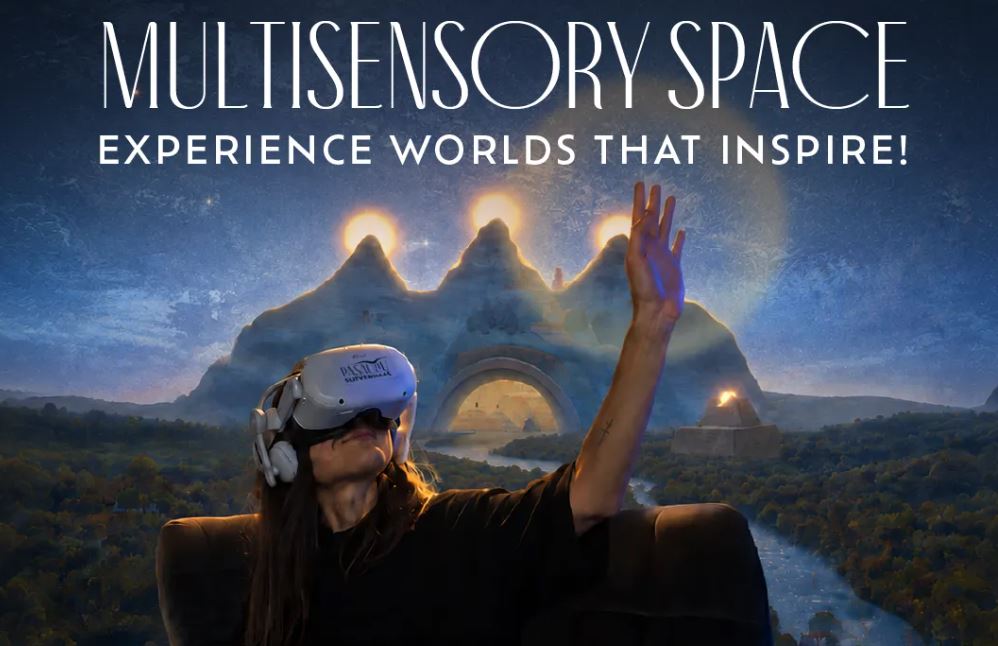
Čiurlionis VR experience (picture from Immersive Art centre)
- Location: Immersive Art Centre, A. Vienuolio 4, Vilnius
- Price: Adults: €20
- Hours: Tue–Fri 12:00–21:00, Sat 11:00–21:00, Sun 11:00–19:00.
Visit Čiurlionis's home in the heart of Vilnius
For a more personal experience, head to Savičiaus Street 11 in Vilnius Old Town. This is where Čiurlionis lived in 1907–1908, after returning to Lithuania following his studies in Warsaw. His rented room was tiny — just 17 square metres — but the building has since become one of the most important places for discovering his life in Vilnius.
The Čiurlionis House was opened here in 1995 and today functions as both a memorial space and a cultural centre. Concerts, exhibitions, educational activities and discussions take place here, making it much more than a traditional museum. For travelers already exploring the Old Town, it is an easy place to add to your itinerary.
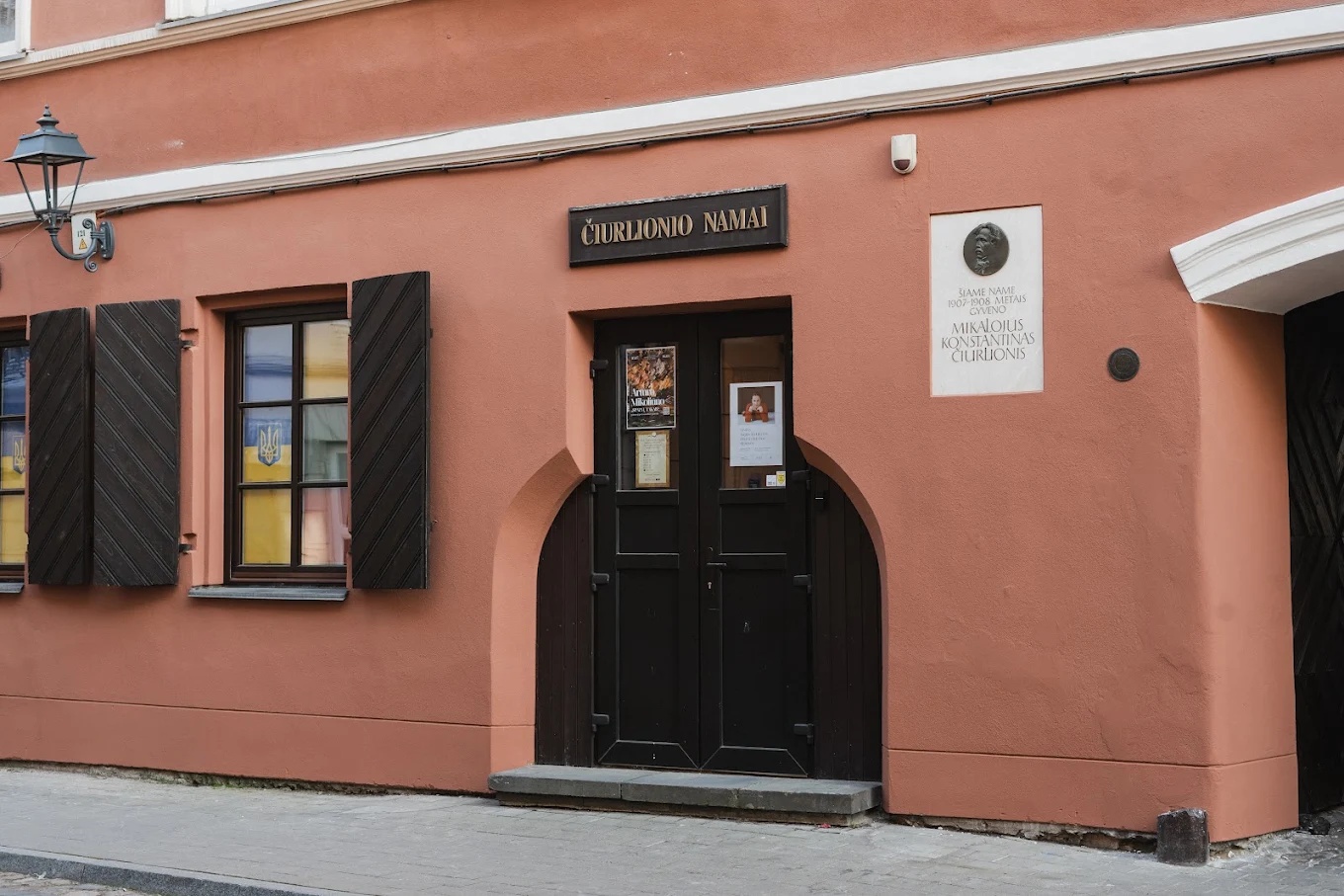 Čiurlionis house in Vilnius (picture from 'Čiurlionis house')
There is a whole Čiurlionis journey across Lithuania
His life and work are connected by the approximately 500-kilometre-long Čiurlionis Route, which links places including Vilnius, Kaunas, Druskininkai, Palanga, Varėna, Rietavas and Plungė. If you are traveling beyond Vilnius, there are several particularly interesting stops.
Kaunas
The M. K. Čiurlionis National Museum of Art in Kaunas holds the largest collection of his artistic legacy and is one of the most important places to see his paintings. The museum is at V. Putvinskio Street 55.
Interestingly, the museum's current 151st-birthday programme includes an English-language guided tour, Čiurlionis's Harmony, where the paintings are accompanied by music and Lithuanian folk songs harmonized by Čiurlionis.
Druskininkai
Druskininkai was particularly important in Čiurlionis's life. His family lived here, and he spent summers here, returning between his studies and travels.The Čiurlionis family home became an important place in his creative story, including the small studio where he worked on some of his paintings.
A practical note for travelers: the Čiurlionis House-Museum in Druskininkai is currently closed for reconstruction. During the renovation, exhibitions and educational activities are being held at the V. K. Jonynas Gallery.
Varėna, Plungė, Rietavas and Palanga
These places are also connected with different chapters of Čiurlionis's life and artistic development and form part of the national Čiurlionis Route.
So if you have more time in Lithuania, following the route can turn a visit to a museum into a much broader journey through the landscapes and places that shaped the artist.
Why discover Čiurlionis when visiting Vilnius?
You don't have to be an art expert to appreciate Čiurlionis. In fact, his work may be easier to experience without knowing too much about art history. Look at one of his paintings and ask yourself what kind of music you imagine hearing. Listen to one of his compositions and see what kind of landscape appears in your mind.
Perhaps that's the best way to understand why Čiurlionis remains so fascinating more than a century after his death.
He spent his short life trying to connect things that are usually kept apart — music and painting, science and mythology, the Lithuanian landscape and the universe, the real world and the world of dreams.