
When visitors arrive in Lithuania, one of the first things they notice is the sound of the Lithuanian language. Melodic yet complex, ancient yet alive, Lithuanian carries echoes of millennia past. It’s not just a way of speaking but a living monument to Europe’s linguistic history. So, where does Lithuanian come from, and what makes it so unique?
The Indo-European Origins of the Lithuanian Language
To understand Lithuanian, we must go back 5,000–6,000 years to the Proto-Indo-European language, the ancient ancestor of nearly all modern European and many Asian tongues — including English, Spanish, Russian, Persian, and Hindi. Over time, Proto-Indo-European speakers spread and diversified, forming the major branches of today’s European languages:
- Germanic (English, German, Dutch, Swedish)
- Romance (French, Italian, Spanish, Portuguese, Romanian)
- Slavic (Russian, Polish, Czech, Bulgarian)
- Celtic (Irish, Welsh, Breton)
- Hellenic (Greek)
- Baltic (Lithuanian, Latvian, and the now-extinct Old Prussian)
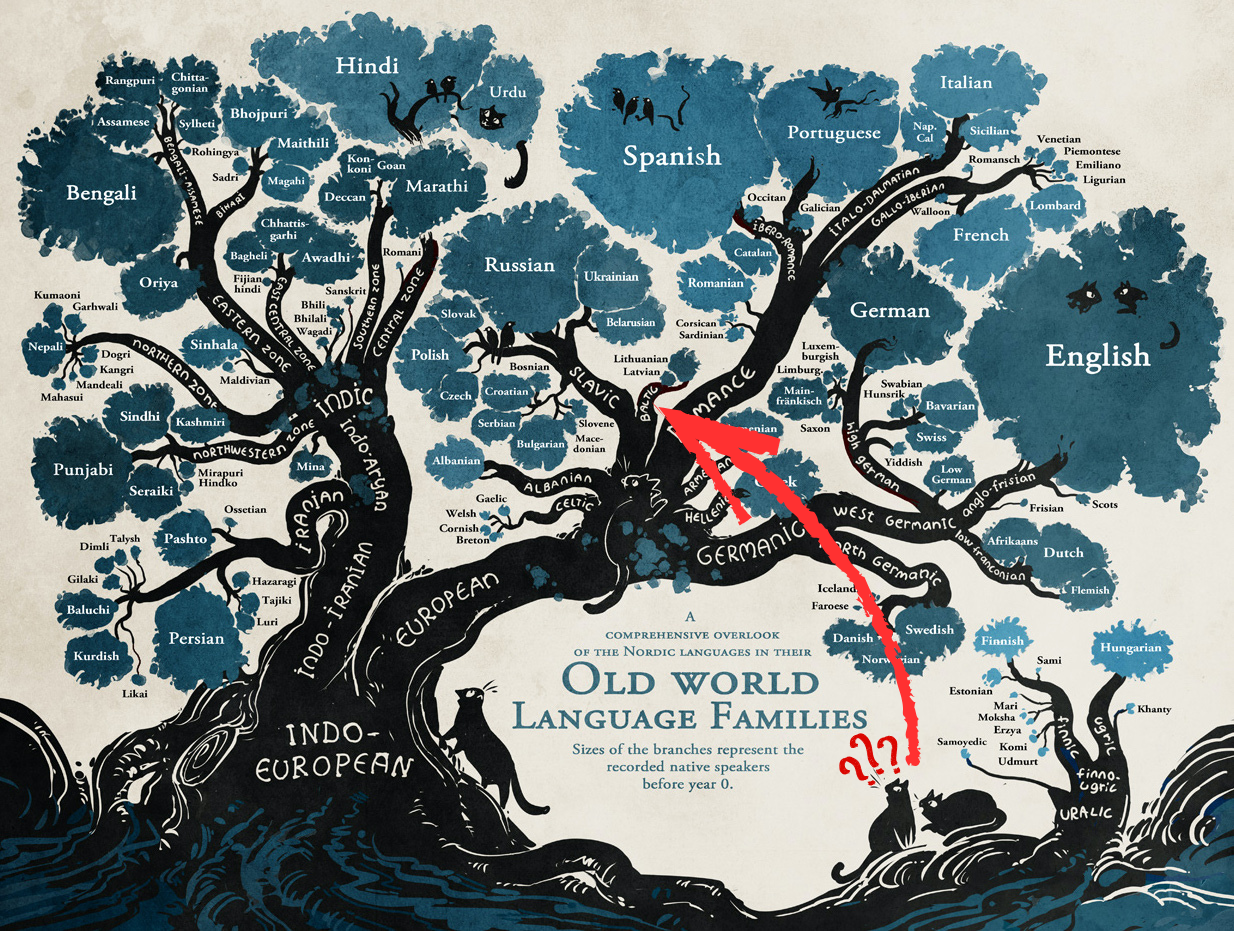 Indo-European language tree (image by Minna Sundberg)
The Baltic Language Family and the Rise of Lithuanian
The Baltic languages developed from the Indo-European family about 3,000 years ago and once stretched across a vast region—from modern-day Poland and Belarus to the shores of the Baltic Sea. Most have since disappeared, leaving only Lithuanian and Latvian as living descendants. Old Prussian, once spoken along the coast, became extinct in the 18th century.

Map of Baltic tribes ( image from wikipedia)
Despite their common ancestry, Lithuanian and Latvian evolved separately and are not mutually intelligible. However, both preserve ancient features, especially in grammar and pronunciation. Linguists regard Lithuanian as the most conservative Indo-European language still spoken today—it has retained sounds and structures remarkably close to Proto-Indo-European.
Why did the Lithuanian language remain so archaic? Its geographical isolation, strong oral traditions, and late modernization played major roles. Situated on Europe’s periphery, Lithuania faced fewer invasions and less cultural mixing, helping its language preserve many ancient traits. Even later, during national revival movements, Lithuanians took great pride in protecting and cultivating their language—ensuring it survived in near-original form.
Lithuanian and Sanskrit: A Surprising Connection
Linguists often call Lithuanian a “living fossil” for its closeness to Sanskrit, the ancient language of India. The two share deep grammatical and phonetic similarities that date back to the Proto-Indo-European era. In the 19th century, scholars studying the roots of Indo-European languages often used Lithuanian to reconstruct ancient word forms. Even today, researchers compare Lithuanian with Sanskrit, Greek, and Latin to explore the origins of human language.
 Some examples of Lithuanian and Sanksrit similarities
Lithuanian for Travelers: Phrases and Pronunciation Tips
At first glance, learning Lithuanian can seem challenging—its long words, unusual endings, and unfamiliar sounds may look intimidating. But don’t worry: locals are patient and delighted when visitors try to speak even a few words!
Here are some essential Lithuanian phrases for beginners:
- Labas! – Hello!
- Ačiū! – Thank you!
- Prašau – Please / You’re welcome
- Iki! – Bye!
- Kiek kainuoja? – How much does it cost?
- Kur yra...? – Where is...?
Good news: Lithuanian pronunciation is phonetic—words are pronounced just as they’re written! The only challenge is the stress, which can fall on different syllables, so listening to locals helps a lot.
If you want to surprise Lithuanians (or make them laugh), try a few colorful local expressions. In the artistic district of Užupis in Vilnius, you’ll find a wall covered with old Lithuanian swear words—a playful insight into the nation’s humor and creativity. For instance, “Po paraliais!” roughly means “Damn it!”, while “Rupūžė” (literally “toad”) expresses annoyance.
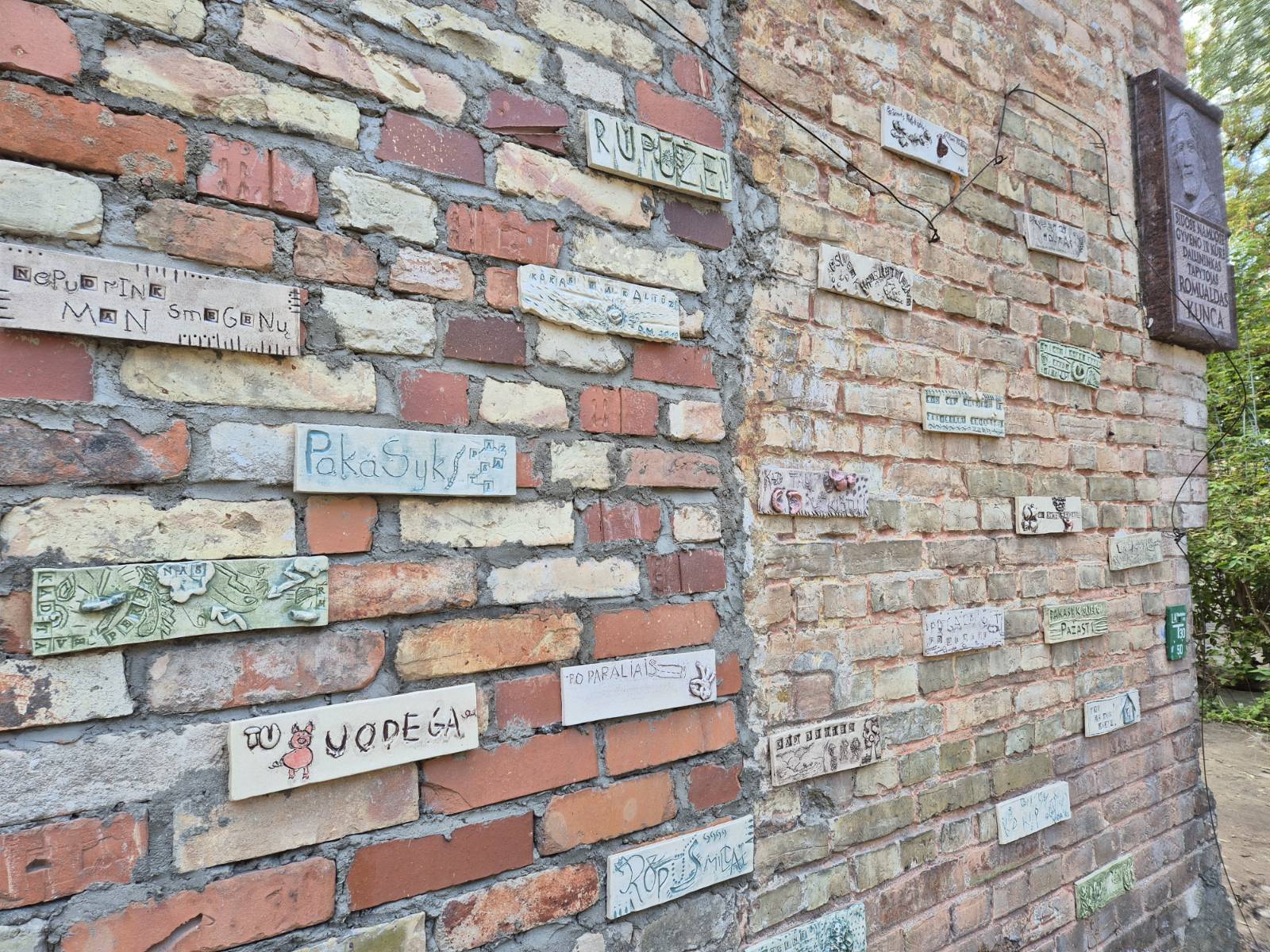 Lithuanian swear words on a wall in Užupis (photo by Vilnius with Locals)
Fun Facts About the Lithuanian Language
- Lithuanian has seven grammatical cases, two genders, dual forms (for pairs), and a pitch accent system.
- It shares roots with Sanskrit, Latin, and Ancient Greek, making it one of the oldest living Indo-European languages.
- The longest Lithuanian word is nebeprisikiškiakopūsteliaujantiesiems, which means roughly “to those who no longer go gathering wood sorrels.”
- Many Lithuanian names, such as Mindaugas or Birutė, have pagan origins dating back to pre-Christian times.
Learning Lithuanian: Where to Start
Is Lithuanian hard to learn? Yes—but it’s also deeply rewarding! What makes Lithuanian truly special is that its words and pronunciation sound unlike anything else in Europe. The language includes several distinct sounds giving it a unique musicality.
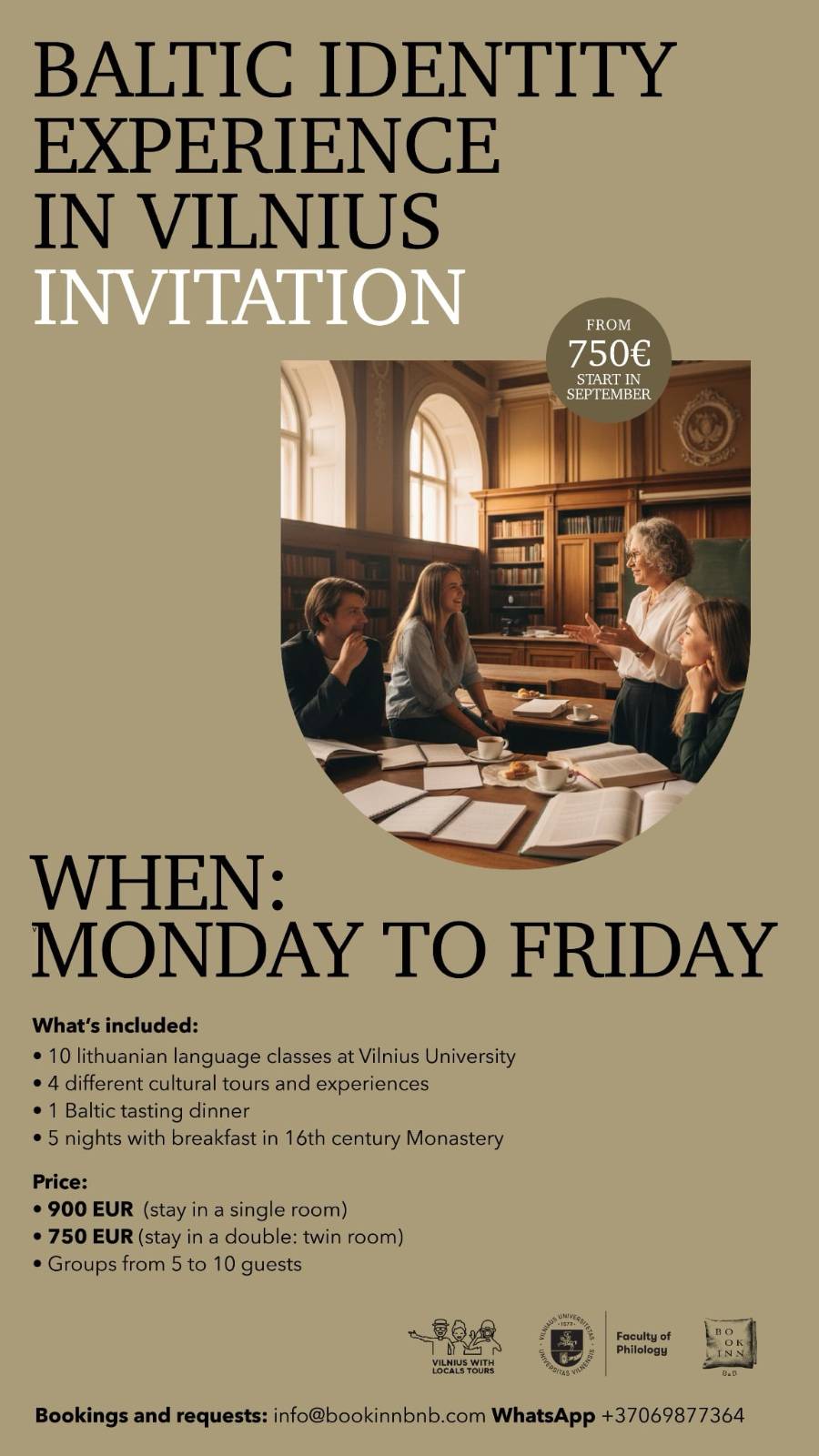
If you’d like to learn the basics, Vilnius University together with partners offer an excellent Lithuanian language course for foreigners—not just lessons, but a full immersion into local culture, history, and Baltic identity. For more information, feel free to contact by e-mail info@bookinnbnb.com.
Lithuanian: A Living Symbol of National Identity
The Lithuanian language is more than a tool of communication—it’s a symbol of national pride, history, and resilience. After the country regained independence in 1990, reviving and protecting the language became a cornerstone of Lithuania’s renewal.
Today, street names, literature, and education all celebrate Lithuanian as both a link to the past and a voice of the future.
So next time you hear the soft melody of a Lithuanian sentence, remember—you’re listening to one of Europe’s oldest living languages, still vibrant, evolving, and as warm and welcoming as the people who speak it.